
When some normal games didn't pan out because of the usual winter scheduling problems, I started pulling notes out of the previous world building posts (session one, session two, session three). The vault, what I'm calling "The Codex", started filling out. Connections could be drawn between beings, places, and events. These inferences and new ideas should be saved, without dwelling on them. They can always be fleshed out later.
There are a few orphan clusters but I'm sure a connection will be made when the time is right.
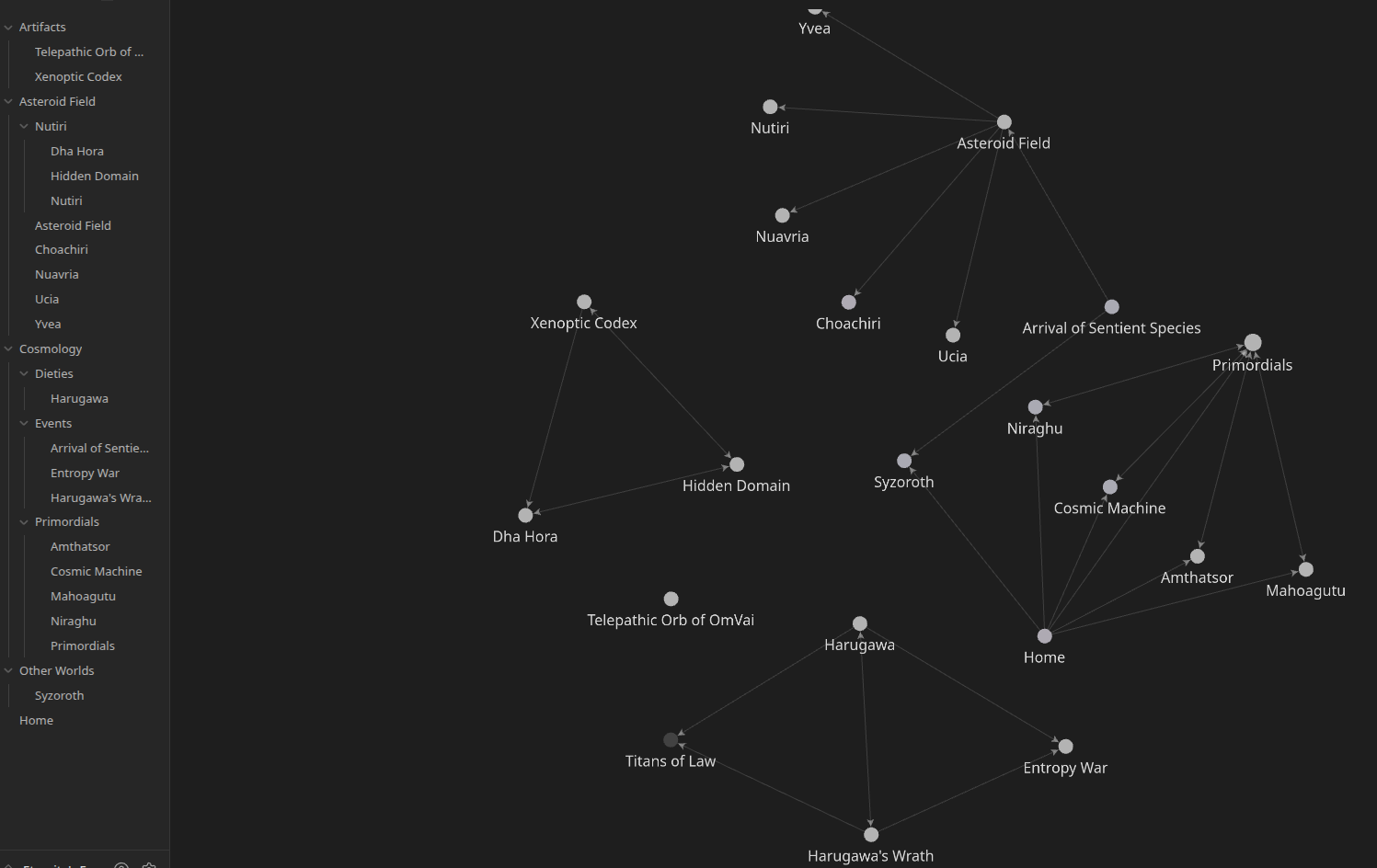
Sharing Notes
Started looking into what it would take to use the Codex's Obsidian files as the basis for a static site so I can build a public knowledge base for the world as the building goes on. Didn't seem to be much going for using in an eleventy site. Still looking at options and it doesn't have to use eleventy. As long as making this an entire new project is avoided, everything will be alright.
Future Stuff
There will probably be a late-stage renaming pass. The method of just rolling with the Nomicon is okay but not always ideal for the space wizard metal tone. The planetoid names being an example.
Some table results will need revisiting in a "Make It Metal" pass. Specifically, the Cosmic Machine (the Eternity Engine?) and the Primordials, needs something more dynamic or confrontational.
Tome of Worldbuilding Session 3 - Broken Worlds
Previously
Earlier posts documenting my process of building a world with the Tome of Worldbuilding:
- Genre & Theme - Heavy metal gonzo sword & planet in an asteroid belt
- The Cosmic Machine - The universe is a self-replicating machine intelligence composed of the forces of Law, Neutrality, and Chaos
This World
Asteroids, Planetoids, and Dwarves
When the book refers to a continent, for the purposes of this build, it will actually translate to asteroids, planetoids, and dwarf planets. Asteroid and planetoid mean the same thing but they'll be Interchangeable based on the vibe.
Dwarf planets are asteroids large enough - from 540-600 mile diameter - to be spherical and should not be the norm. Use one for a "mini-earth" to anchor this sector of the asteroid field and be used as the starting continent for the book processes. To be decided if there is another dwarf planet close enough to be mapped.
Asteroid References
Sources used mostly for figuring out sizes of our asteroids.
- https://www.qrg.northwestern.edu/projects/vss/docs/space-environment/1-asteroid-planetiod-meteoroid.html
- https://www.britannica.com/science/asteroid
- https://www.britannica.com/science/small-body
- https://en.wikipedia.org/wiki/Asteroid
- https://en.wikipedia.org/wiki/Dwarf_planet
Planetoid Sizes
For the main continent, we'll use the maximum size of an asteroid that's considered a dwarf planet, which is a 600 mile diameter. This is 1,130,973 square miles, which is 1,063.47 miles horizontal by 1,063.47 miles vertical for a map. If we use 30 mile hexes like the book, we'll get 35.5 by 35.5 hexes. Round it up to 36 by 36.
Other planetoids in this sector should be smaller than the dwarf planet. They'll likely be mono- or dual-biome environments.
Earth's Size
For comparison, the Earth is 197,000,000 square miles which comes to 503 by 503 thirty-mile hexes. Australia, according to the book, is 3 million square miles, which would be 62 by 62 hexes. This makes the dwarf planet around half the size of Australia.
Number of Planetoids
For the main grouping, roll 1d10. A result of 4 gives us three planetoids in close proximity. The book's result says the continents should be interconnected around a sea like the Mediterranean. Converting that idea to our setting, maybe the three major planetoids could have a relatively easy way to traverse from one to the other. This could be distance or a technology enabling fast travel among the three.
One of these should be the dwarf planet, which would be the the starting continent. The other two could have a smaller randomized diameter.
The second grouping of "continents" gets a result of 2 on 1d3+1. This means there are two other planetoids further out from the tri-body grouping. These may be smaller or include the second dwarf planet.
Since we have five planetoids, they need to be named! Using the Nomicon's "Names for Continents" table:
- Dwarf Planet 1 (main): 44, 82; "Nu" + "tiri" = Nutiri
- Planetoid 2: 10, 16; "Choä" + "chiri" = Choächiri
- Planetoid 3: 45, 90; "Nua" + "vria" = Nuavria
- Planetoid 4: 75, 17; "U" + "cia" = Ucia
- Dwarf Planet 2: 86, 84; "Y" + "vea" = Yvea
Weirder Planetoids
We're already "getting weird" with the underlying physics of a habitable asteroid field so didn't need to use this table. Maybe useful for ideas later for asteroids outside the current sector.
World Mapping
The author talks about different map projections, including use of the Traveller hex maps. This seemed appealing and maybe even have the right vibe for the pseudo-sci-fantastical theme but in the end it wouldn't be necessary and no one would care. I can't remember ever using an accurately-projected map in an RPG.
On the question of mapping linearly vs using squares vs hexes, hexes are the obvious answer. They're the standard, feel natural, and matches the book's default. The book does give a strange justification for using hexes: their tactical nature. I'm not sure how that's relevant to for continental maps.
To recap, 30 mile hexes, because it's the book standard and a good all-around size for continents (or planetoids!).
Zones
Equator
To start, this is at the scale of the dwarf planet Nutiri. Smaller planetoids may not have equators. A dwarf being 36 hexes high gives a middle row of 13 with the equator being on the south edge for a northern hemisphere. The opposite for the southern hemisphere.
Life Zones
The book lists out Holdridge Life Zones for use in mapping the climate on a planet. These are polar, sub-polar, boreal, cool temperate, warm temperate, subtropical, and tropical.
Those life zones are probably too many on even the largest - the dwarf planet. Will probably be scaled back. On smaller asteroids, reduce the number of zones. Possibly randomizes a central or dominant zone type for small planetoids. Some asteroids may be mono-zoned. For the sake of randomization, add a "Desolate" biome to represent an area with no atmosphere or otherwise hazardous environment.
Using the biomes from the standard zones, each one would occupy 2 hex rows in a band around the dwarf Nutiri - except one zone in each hemisphere would only have 1 hex row. That's pretty tight and might make changing of the weather a focus of the game. Some weather impacts add challenge and fun but let's not go overboard with it. Switching to the shortened biome list of arctic, subarctic, cool, warm, sub/tropical, each biome occupies 7 hex rows except one in each hemisphere that takes 8. That's a lot more breathing room.
I tried randomizing how many hex rows a biome strip occupies with the long and short lists. Nothing I rolled was very satisfying and resulted in a narrow climate on the dwarf planet. The even distribution of a 7/8 shortened list made the most sense and the most fun. This gives enough variety without making multiple changes in temperature too common with ground travel.
Nutiri's northern hemisphere is slightly warmer than the southern.
The climate bands now look like this for the dwarf planet:
- N Arctic = 7 hex rows
- N Subarctic = 7 hex rows
- N Cool = 7 hex rows
- N Warm = 7 hex rows
- N Sub/Tropical = 8 hex rows
- Equator
- S Sub/Tropical = 7 hex rows
- S Warm = 7 hex rows
- S Cool = 7 hex rows
- S Subarctic = 7 hex rows
- S Arctic = 8 hex rows
Catastrophic Change
As a means to explaining the physicality of the world, the setting's magic and tech levels, and the factions we can use the standard trope of a past catastrophe being at the root of current affairs.
On the Catastrophe table, a 4 is rolled with a d8. This gives the result of a "divine or unholy action". Not something I would choose and definitely not expected. That cuts off a few possibilities going through my mind already.
Moving on... It was established earlier that some gods directly interact with the mortal world so this could make sense.
The book suggests an evil group or individual being responsible for nullifying the power of the good-aligned deity faction. That nullification enabled the evil deities the freedom to cause wanton destruction. This evil group or being is still around, lurking. Always threatening to come back.
First, we'll change the dichotomy of good vs evil to law vs chaos because of the Cosmic Machine and the Primordials.
Maybe it can be both a group and an individual. A chaos cult dedicated to reviving the dormant god... using Nomicon's "Eldritch god names", two d100 rolls give 49 for "Haru" and 7 for "gawa"... Harugawa. This god of raging entropy waged war against the Titans of Law, resulting in the shattering of reality that resulted in the endless asteroid field. Harugawa's Wrath, Vengeance, Folly - it's depends on who you ask.
Using our hex maps
Based on the info from this session, there's a requirement to print out some 36x36 hex paper. I used a tool linked to from a post on Spriggans Den to make a 36x36+ hex grid on 8.5x11 paper.
Next
That was more effort than I was expecting compared to an earlier test run of this early process that just used continents on one world. Things are taking shape! The next step is to get a zoomed-out look at the other planetoids and leave the starting dwarf planet, Nutiri, for later.
Tome of World Building Session 2 - The Cosmic Machine
Previously
In a previous post, I started using the Tome of World Building to create a fantasy setting with the intended theme of sci-fantasy/sword & planet with room for being either serious or over-the-top gonzo. Instead of a typical planet or something weird like a torus (looking at you Stars Without Number), it would consist of an asteroid field with larger planetoids giving larger areas to play in. In the terms of ToWB the theme is "Heavy Metal" and the setting will be a High Magic one.
Ground Rules
1. No Target System
The goal of this exercise isn't to use this world in a specific campaign. It could be used in a game but there shouldn't be an obligation.
2. [Mostly] Obey The Dice
The book mostly consists of tables and they're going to get used, dammit. Follow the dice where they land unless it doesn't make sense with what's come before. Ditch previous world assumptions if the dice go that way.
When the book asks a yes/no question, dice will determine our fate by rolling a 1d6. A result of one through three results in a "yes" answer and four through six a "no".
The numeric dice results aren't always going to be recorded on the blog, especially with binary questions. I'll just write the result and any implications that has.
3. Roll For Names
In the beginning, a naming system was used from a previous campaign. It takes an approximate translation from English to Old German then modifies that to obfuscate it and improved the way the word sounds.
After a while, that seemed to take more up-front effort than just rolling dice. Instead The Nomicon, also from Mythmere Games, will be used to find random names. In some of these world building session recaps a pre-Nomicon name might appear in front of the Nomicon version.
The Cosmic Machine
Chapter Two from the Tome of World Building helps establish a cosmology and some other details, like legendary books and how the world's inhabitants got there. It makes two assumptions necessary to use the book. Do these assumptions work with the heavy metal sword-and-planet theme?
The first assumption is that the multiverse is complex and populated by gods, planes, and other types of worlds. That would be an enthusiastic "yes"! All of these possibilities should be open in the gonzo atmosphere of the sci-fantasy asteroid/planetoid field. In some ways I'm picturing this is an extension of an "Edge of Space" mini-setting I once used in a Dungeon Crawl Classics campaign. It had space travel in wizard tower rockets, inter-planar tunnels through spacetime, Chaos lords, and archons of Law even if the deities themselves never showed up.
The other assumption is that communication by the these deities is both rare and cryptic - something to be interpreted and even fought over. I had been assuming the gods should be involved in local drama and maybe even just be powerful ascended techno-sorcerers and immortal despots. Maybe too much influence from the Immortals of BECMI but that just seems more fun and in line with the setting's vibe. Let's make this a "maybe" and see how it goes.
Deities, Forces, and Primordials
The book now teases information out of the world builder with a series of questions. The big one is probably this: "Is there a creator deity?" I roll a five, so the answer is "No". That lends more mystery the world as opposed to having a Big Boss.
Moving on, the question becomes "Is there a hierarchy of gods/forces?" The author makes sure we know this doesn't mean something as simple as less/greater gods but about how our cosmic beings are woven into the setting. It's less one big question and more a series of smaller ones.
Are cosmic forces linked to alignment?
A "yes" is rolled. These forces can represent all alignments on a nine-points system or just be down to so the core concepts of Law, Neutrality, and Chaos and that these are natural forces of the cosmos. Possibly more powerful than deities. This is obviously going to lean into the Moorcockian vibe of Law vs Chaos. Already, my GM brain is thinking Black Sword Hack for a system, if not just Swords & Wizardry.
The Nomicon gives us the names for these primordial forces, who are going to be referred to as the Primordials. The Eldritch God Names table results:
- Law: Amthatsor
- Neutrality: Niraghu
- Chaos: Mahoagutu
Appropriately, these forces are the first things to be named in this new world.
How does a creator deity fit into the multiverse?
We've already answered this but the text then goes on to the possibilities of how the world came into being without one. With this setting, it would make sense that the world came into being as the result of the Primordial forces interacting with one another, birthing the gods and the rest of existence.
Are there lesser creator deities that create worlds?
This creates a category of deities that are world creators versus ones that aren't. Following the "no creator deity" path and the influence of the Primordials on reality, this is a "no" without rolling.
Are there deities that can't be worshiped?
Rolled a "yes" so we do have some gods that are not to be worshiped and whose names should not be uttered. Malevolent deities and those banished to the material plane for whatever reason. Maybe they are sometimes worshiped in secret.
Are there deities that mortals can interact with?
"Yes", although they might still communicate in confusing or obtuse ways. Not every god will spend time with mortals but this opens the door to angering a deity or just misunderstanding what they want.
Do deities reside on the material plane?
A "yes" is rolled on this question. The book emphasizes this being of major importance to the world build process as a whole. These "earth"-residing beings can be super-powerful monsters like dragons, minor godlings, or otherwise immortal creatures and not necessarily full-fledged gods as we typically think of them.
Nature of alignment cosmic forces
Since a link was established between alignment and the Primordials, it's time to think more about the nature of these three forces. This, the Nature of Cosmic Forces, is the first table in the book!
Rolling a d100, the result is "Artificial Intelligence". Are the Primordials AI themselves? No, that's too close to Mutant Crawl Classic's patrons. Instead, the Primordial forces of Law, Neutrality, and Chaos - or Amthatsor, Niraghu, and Mahoagutu - are themselves cogs in the greater Cosmic Machine of the universe, making up it's intelligence and processes. This might paint us into a corner with the universe being created by the interactions of these Primordial cosmic forces. Something about that uncertainty appeals to me and it shouldn't be hard to square, so we'll go with it. It's one of things that probably won't come up in play anyway.
Strange Artifacts
These tables almost seem out of place when discussing cosmic forces and the nature of deities. They're fun, though, and do establish some greater hidden history of the universe that mortals weren't meant to know. Maybe these are the only things to give a glimpse into the beginnings of time and reality.
Legendary Book
This is the setting's Necronomicon. It's an ancient tome of forbidden knowledge that risks insanity, the attention of evil beings, and illegal to possess in most societies. Using the Legendary Book table's multi-column layout, the result turns out to be called the Xenoptic Codex. Love it. The fourth named thing in the setting.
Looking at exactly what a codex is, they're typically an ancient manuscript of religious scripture and other ancient wisdom. Fair but I don't want something so old and important to be a must tome that could rot. Instead, I'm picturing an ancient technological device, unlockable by ritual or magic, such as a geometric computational device or a data crystal used in a lot of sci-fantasy.
Where is the Xenoptic Codex now? Luckily there's a table telling us the name of its location, which is The Hidden Domain of Dha Hara. I don't know who Dha Hara is. Maybe they are one of those unworshipable, unspeakable deities banished and shunned for their knowledge on the true nature of the Primordials and the Cosmic Machine.
Stranger Than Books
There's another table for another medium of ancient knowledge to use instead of a book. We could also have both in the world - why not? The first result was the Reciting Tablets of Cha Hartha but it sounded too religious and primitive. I want something that complements the current themes instead. On a re-roll, the result is the Telepathic Orb of OmVai. The Orb probably doesn't store knowledge but provides a relatively easy way to acquire it and sounds like it grants psionic powers.
So we have the Xenoptic Codex, a legendary data crystal and the Telepathic Orb of Omvai, a psionic stone orb or crystal ball. Although.... maybe the orb should be something else. An actual giant-sized eye? This might even be able to tie into the Eye of the Cyclops from my first blog post.
Arrival
The chapter wraps up by prompting the builder to answer the question "How did people get to this world?" Did they evolve from primitive life forms or where they created by gods (no)? I think we'll leave that specific unanswered. As far a how intelligent life arrived on our world, the text suggests "Space Travel" for settings aiming for a Heavy Metal feel, which is what we're going for. The other option is via magic portals which is also cool but we'll stick to the space travel angle.
There are a lot of options for where they traveled from. Rolling the dice given the suggestions in the book gives a "distant planet". Let's say it's outside of this world's star system and they arrived using a large colonization vessel. The ship itself is lost to time and may still exist somewhere (adventure locale!). I first named this previous world Klyscuzabal but didn't like that and rolled using the Nomicon to get Syzoroth.
Homework
We finally close out, for real, with a suggested reading list. Covering cosmic alignments are Three Hearts and Three Lions and the Elric Saga. For a more scientific approach Blind Watchmaker and The Selfish Gene. I haven't read Three Hearts..., maybe I should rectify that sometime.
Summary
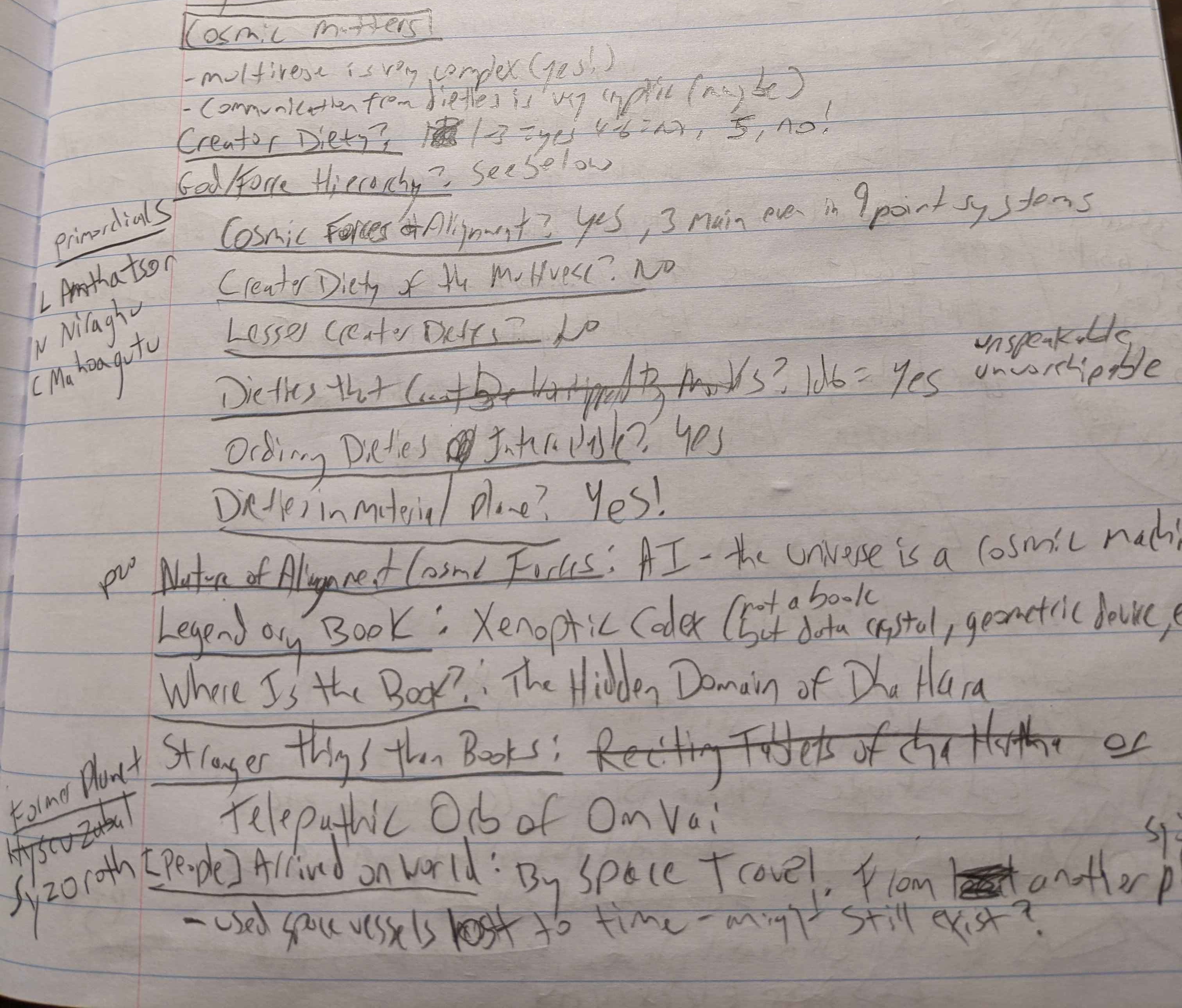
- Instead of being created by a deity, the universe was formed when the Cosmic Machine's forces of Law, Neutrality, and Chaos interacted in just the right way.
- The Cosmic Machine is itself the universe, intelligent, and artificial.
- These forces are known as the Primordials Ahmthatsor, Niraghu, and Mohoagutu.
- The universe has multiple planes, gods, and other powerful beings and places outside of the material world.
- The gods are hard to understand and the their desires are open to interpretation and misunderstanding.
- Some gods are not worshipable and some not nameable.
- There are deities and godlike beings that reside on the material plane.
- There is a legendary item of knowledge known as the Xenoptic Codex that can be found in The Hidden Domain of Dha Hara.
- Dha Hara is most likely a banished and unworshipable deity.
- Another strange artifact is the Telepathic Orb of OmVai. OmVai might be one of the immortal godlike beings.
- The sentient species of the setting came from the planet Syzoroth on a colony ship, long ago crashed and forgotten.
Next
In the next chapter, we get down to earth and start mapping things out. Edit: Ok, not quite yet but we do look at the world itself.
AD&D Play Report - Session 11 - Intro, Fog of War, A Fight
Intro
Back in June I decided to join an Advanced Dungeons & Dragons newbie group as a means to refresh my take on the rules rather than just read them. The OSR seems to mostly revolve around Basic and OD&D with AD&D games being the exception. I have played in one previous AD&D campaign in my adult life but it wasn't good for understanding the rules - just antagonistic GMs.
To re-learn the game I wanted to approach this edition with a beginner's mind - jump in as a newbie and not make any assumptions. I wanted to dive into the rules that are a step in the crunchier direction than previous editions. My reasoning was to use this experience as prep for an AD&D (OSRIC 3, really) campaign. That campaign may never happen - it's competing with other itches to scratch. I answered the call for players anyway.
It turns out the GM, is also the developer of an AD&D-focused web app called AD&D Toolkit. We're using it for character sheets along with Discord for voice/chat, and Roll20 for maps and dice.
The Toolkit is great, especially coming from a one-person development team. It removes the pain of encumbrance tracking and calculating movement speed like you can do with a VTT. I can't figure out if it would be better with dice rolling also or that would just bloat it.
For this game I'm playing my surviving character, Stannum Rosekeep, who's a "steal from the rich, give to the poor" sort of thief. This is a good opportunity to see how the AD&D version of this class plays out compared to Swords & Wizardry, Labyrinth Lord (not an affiliate link), and Old School Essentials.
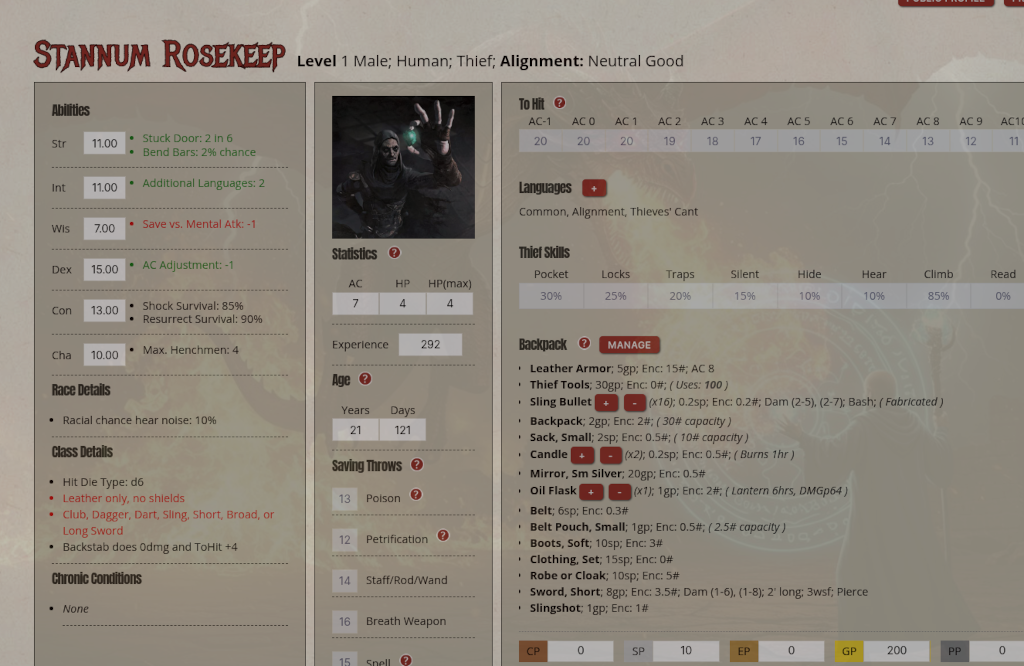
The only weapons available to AD&D thieves are club, dagger, dart, sling, and sword. The AD&D Player's Handbook claims this is a "fair number of weapons"
but without a bow of some kind, it feels limiting from a modern perspective. What's a thief without a bow? The thief skill chances to succeed are also slightly different than other editions and clones - something that others have blogged about extensively. I've still never come to an opinion on any of the old school thief implementations. As a GM, I like the party to have one but from the player side the utility vs fragility is questionable. Anyway, it's going to be a challenge!
The Fog
With that background out of the way, we can move on to the play report. For this campaign's reports going forward, we're focusing on lessons learned from the GM to take to other games and becoming familiar with the system. It is a learning campaign, after all.
The party started on the coast of the nation of Karmont. Most of the regional map is unseen hidden by the fog-of-war but the GM does show hexes once they've been traveled. We can see Concordance Bay, the nearest body of water. There's a shoreline labeled Cliffs of Keltheald and the implications of a river mouth. The settlements that the party has visited are shown, sharing a common road:
- Sotfen, coastal city
- Seaway
- Drayonn to the north
To the west of Drayonn is a kobold camp among a forest.
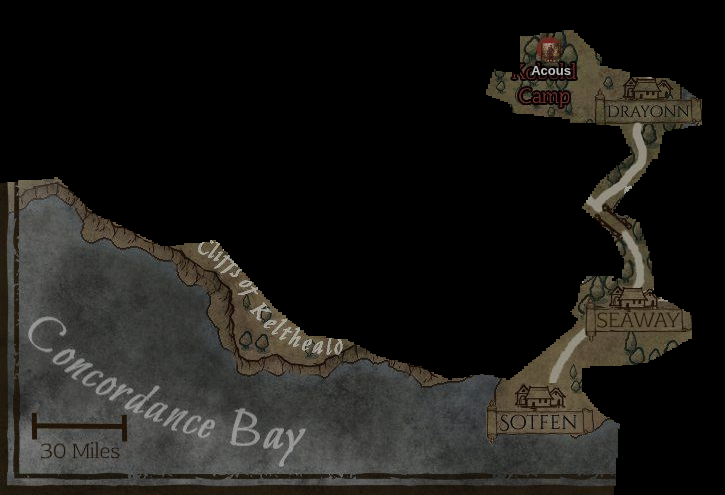
I've used this heavy fog-of-war for hex crawls in the past. Seeing this in action as a player is a bit awkward - wouldn't our characters know more about this area? Are we from a foreign land? I don't recall this being stated at the beginning of the campaign but that could be my memory. This does remind me of the Forlorn Encystment post "Strangers in a Strange Land". In that post, about how the implied setting of AD&D is almost certainly the situation in which the PCs are new to the area.
I'm making note of this for future sandboxes. How much knowledge of the surrounding area should players have?
Actual Play
At the end of the last session, we were in Dragyonn licking our wounds after scouting the Kobold party and running into some as random encounters. This scouting missions was at the behest of Drayonn's mayor but the gold bounty for kobold heads was given to us by the governor of Seaway. Gathering heads has been our main focus when we're not managing inventory and rations for our expeditions. The struggles of first level.
We resupplied before meeting with Drayonn's militia on the route to the kobold camp, as previously discussed with the mayor. We were attacked by a kobold scouting party while camping overnight - we couldn't do without a fire because the weather effects would have hurt us mechanically. This was where AD&D's weather rules came into play. The party planned to sleep without a a campfire to maintain a stealthy approach as we neared the camp but brutal cold reality practically forced us to have a fire. Either way, we took care of the scouts.
The next morning, we made our way into the camp. We decided on a frontal assault using a formation we came up with earlier in the session. We took out three waves of the enemy and a fleeing kobold - that we guess was heading off to warn a larger lair. I stuck to range attacks with sling bullets the entire combat. This worked out well, even though I had a non-proficiency penalty in their use - I took two melee proficiencies at creation.
One of the party was taken down near the end of the battle - our newest paladin. As far as treasure, there was virtually none other than cheap weapons to sell and the skulls of kobolds. We wrapped up the gruesome task of head gathering and returned to Drayonn. There we could pick up the rotting heads we left behind and recover in preparation for traveling to get our reward from the governor.
Tome of World Building Session 1 - Genre and Theme
No Pressure
The usual method recommended to RPG world builders is to only build what's usable when starting out. This is a bottom-up approach starting with an adventure location and a relatively nearby settlement with NPCs, goods, and services. Keep the world lore local and manageable then expand from there as needed.
This has worked in the past for my campaigns. These local-first worlds leave me with an itch to expand but it keeps focus on the practical and helps avoid bottomless rabbit holes.
After getting the Tome of World Building I wanted to go all in from the top-down. Not committing the end result to an upcoming campaign removes the pressure of delaying the start of a game. Instead, I'll add the pressure of blogging the process!
Genre and Themes
I came at this with a rough idea of what I wanted: a sci-fantasy/sword & planet setting consisting, instead of an Earth-like planet, of an asteroid field peppered with a larger planetoids and no concern for the specifics of atmosphere and gravity. Thematically a cross between Thundarr, Metal Hurlant, Flash Gordon's Mongo. Chainsaw swords, cyber-wizards, and ships sailing the space between worlds. Practically at the table, a swords & lasers "nautical" game, with each self-contained location reachable by vehicle or flying mount.
Looking at the Tome's genre descriptions, I chose "Heavy Metal". Seemed appropriate. Based on suggestions from the book, this will include themes like:
- Anti-hero PCs. This is almost a given, anyway, but never leave things black and white.
- SciFi elements mixed with fantasy. Spaceship wizard towers, laser-wielding cybertigers, alien fiends, and unique biomes.
- Strange and varied cultures. If I fudge table rolls, lean towards big, weird differences between these nations.
- Many unexplained and unknowable mysteries about the nature of reality. Conveniently, this can include being able to breath in space.
- The "world wider" and "villains more evil". An endless number of asteroids and rocks for cultures, warlords, monsters, fortresses, and dungeons. Big bads will be despicably evil.
- Prophesies are important to the setting and likely to happen. This is something outside my usual wheelhouse since I associate fantasy prophesies with overdone The One trope.
- Everything is strange and bigger than life. This includes descriptions of the surroundings, larger cities, gargantuan fortresses, and the like.
- A lot of wilderness and points of light. Each civilization's locations being somewhat self-contained lends itself to this kind of setting. I just need to leave room for a good amount of unexplored planetoids and asteroids to provide an untamed wilderness between each city.
Go Low or Go High?
The question of High Magic or Low Magic comes up next. I would answer "Low" if asked my preference here but what sounds like a gonzo setting just needs to be one of High Magic to complement the hand-wavy SciFi.
Next
Next time, we're really starting from the top with the setting's cosmology. Typically, this is the first drawn out rabbit hole I might go down.
And the x-ray image is in. Just a few shattered fingertips, no big deal. At best, a month of healing.Blunt Damage Follow-up
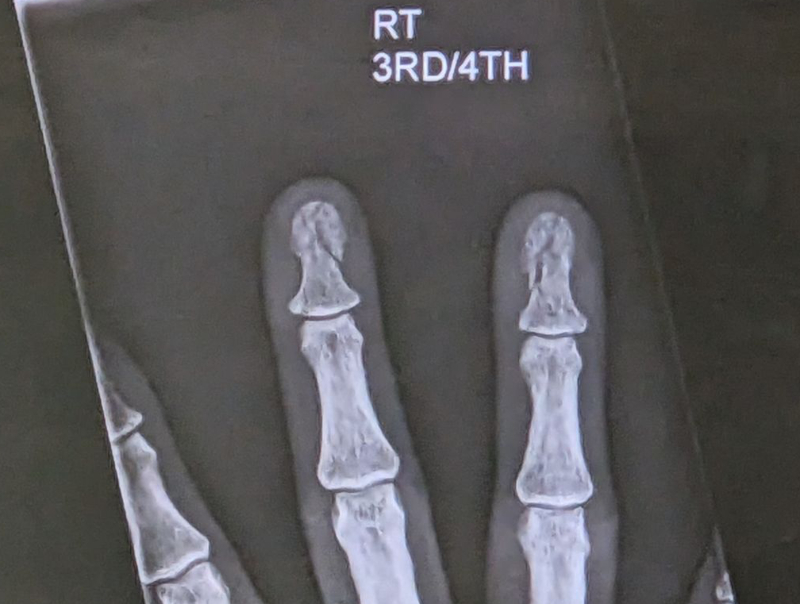
So, no bass guitar for a while. Trying to master touch-typing with just a left hand, right index finger, and right thumb. That's okay until I have to move around in vim, my chosen editor. Now I see how inaccessible that software is.
A fun thing happened last Friday. A heavy cutting board fell three feet from a shelf. Edge first. Htting a very solid wood surface. The problem was that my hand was in the way. That hand/eye coordination trained from youth through countless hours on controllers were no use now. I was too slow and it hit two fingers on my right hand.Blunt Damage

Of course, I waited a week for the swelling and pain to subside. The fingers weren't swollen any longer but the throbbing pain persisted. I continued to work, pack for our move, and shitpost. Eventually, I relented to my spouse's pleading and went to the doctor.
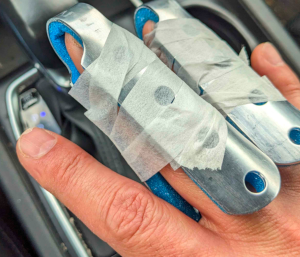
Turns out I broke two fingertips! The splints are annoying but typing this post wasn't too painful, just slow-gowing.
The last two packages I've gotten in the mail have spilled their contents. "Ooze Nun" is an adventure for Mothership - not sure how if I can slot this into the current campaign or not because it looks crazy. "Zombie Braineaters! Suburban Decay In The U.S.A." is an RPG that looks like a fun take on the well-walked zombie genre.New Zines - Cloud Empress, Mothership, and Zombie Braineaters
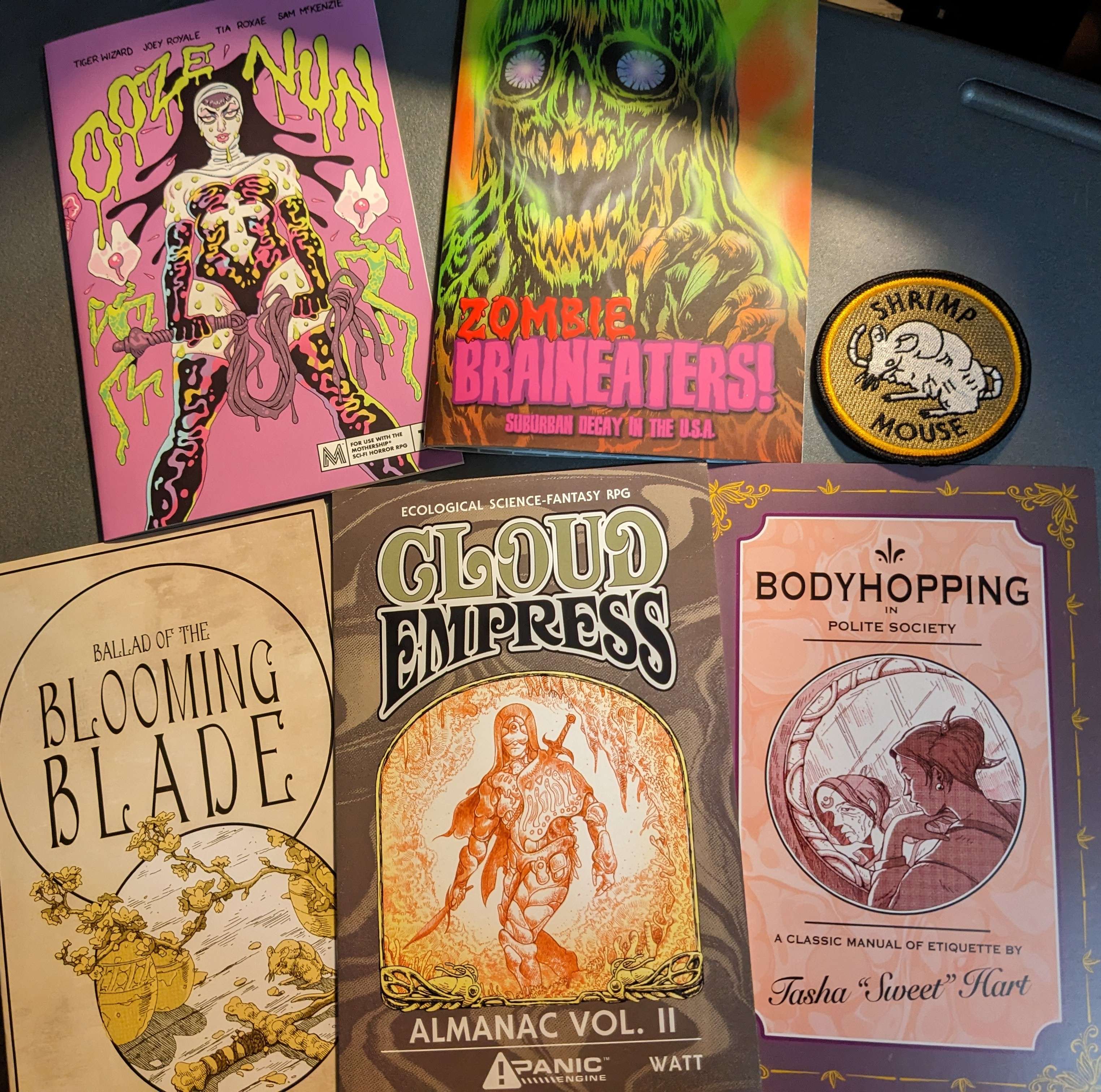
The three Cloud Empress zines and the shrimp-mouse patch are from the latest Worlds By Watt crowdfunding campaign "Stories From The Slip Vol. 1".
I haven't decided if I'll write up reviews of these from just reading them or from actual use at the table. I'm opting for the latter, so it might be some time before I can. I do have a campaign that is coming to an end soon. We'll see.
The Fediverse isn't the busiest hive of RPG activity but it's where some of us call home, even if only part-time. To get a handle on what others are posting on their blogs in this little corner of the internet, I'll put this list together. These are all blogs from responses to a Mastodon post I made this morning.Fediverse Blogs
These aren't meant to be federated blogs but blogs written by Fedi users themselves.
While these links are in the side bar, I'll also try to keep this post updated for a permalinked list. If your blog is listed here and needs correcting or removal, let me know with a private post on Mastodon.
- 6d6 RPG Blog - RPG content
- Among Cats And Books - Factions and sandboxes
- Archway of Glowing Orange
- Dogwood Tales - RPGs & other media
- Fight in the Shade - OSR and traditional TTRPGs
- Githyanki Diaspora - Judd Karlman from Daydreaming about Dragons' Blog
- In My Campaign - RPG design & play
- Marc Ueberall - Solo RPG plays
- The Monsters Know What They’re Doing - Ready-to-Use Tactics for D&D 5E
- Polyhedral Dreams - Thoughts about TTRPGs
- Polyhedral Nonsense - RPG curiosities
- Reviews from R’lyeh - Reviews of RPGs and their supplements
- Signals from Delta Pavonis - Gaming, books, SF, computing & life
- Spriggan's Den - Sword & sorcery RPGs
- Thought Punks - RPG design, free games
- Thoughts in Darkness - Melting pot of ideas
- Troy Press - RPG design, GM prep
- TTRPGs - TTRPGs
- Vague Countries - DIY D&D
- VDonnut Valley - TTRPGs
- Weaving Stories - Game design & stories
- Whispers from the Sky-Spire - Adventure Reviews
Edit: Added more blogs!
Minor update on the blog. Finally added slugs for URLs on posts. For some reason I thought it would require setting up another plugin but, of course, that's built into 11ty.Slugs All The Way Down
I'm working on digitizing my journey through Matt Finch's Tome of Worldbuilding. Hoping to have the first part of what will be a series. I have a few sessions working with this book in a paper(!) notebook.
I was inspired to start this blog because of the theme going around a lot of blogs was "Appendix N". It got me thinking about my influences. They don't all make sense but I am what I am.Appendix Null
The last straggler in the "Appendix N" posts came from Afraid of Encounters. Well, I can't be THAT lazy and with some encouragement from peole at the Prismatic Waystation Discord server, real life business, and procrastination I stream-of-concsioused my own Appendix Null.
This is semi-chronological. Apologies to any influences I forgot.
Kid Loitering In Used Bookstores
- Tolkien - the runes and descriptions of trees, pipeweed (foreshadowing)
- Alan Dean Foster's Humanx Commonwealth - praying mantis aliens, psionics, Quetzelcoatl aliens
- Elfquest - alien elves, cool mounts, might explain bi
- Fangoria - monsters and aliens, forbidden rated R
- Thieves' World - thieves, hub city, pentagram on forehead
Kid Loitering At The Gas Station Comic Stand
- Kirby Devil Dinosaur - poor kid's Kamandi?
- Micronauts - a multiverse as they say these days
- Ninja and Mercenary magazines - shuriken and nunchaku, Rambo shit
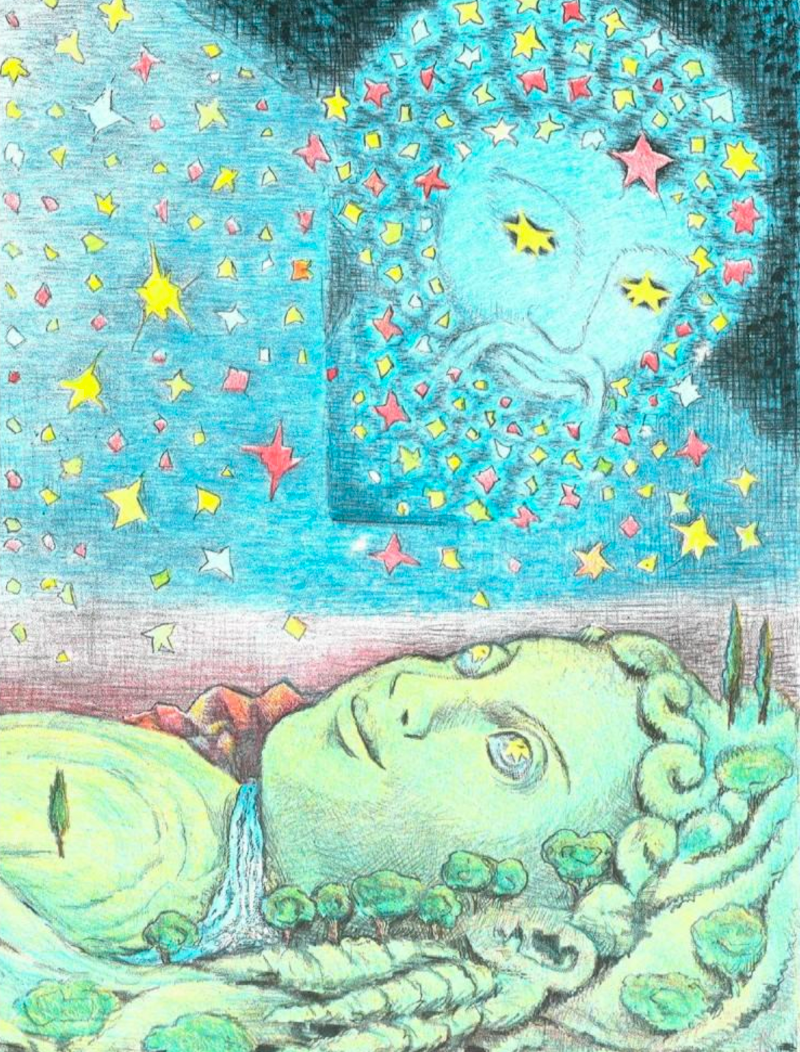
Getting Beat Up At School
- Moorcock's Elric and Eternal Champion - drugged-out sex elves, elemental pact magic, chaos lords, multiverse, tragic anti-hero, Tanelorn
- D'Aulaires' Books of Myths - the gods as psychedelic assholes, creepy
Descrambling HBO
- Blade Runner - flying cars and Han Solo
- Alien - Giger, Ripley, Jonesy, working class, FLAME THROWERS
- The Omen - secret devil stuff, freak out check my scalp
- Amityville Horror - flies, these ghosts will kill your ass, the devil
- The Shining - scary, weird, Donner party
- E.T. - playing d&d while smoking, dominoes
- Conan the Barbarian - serpent cults, Crom, magic is evil
- Krull - boomerang named after a polearm
- Road Warrior - battle cars, gyrocopters, eating dogfood
- The Thing - body horror, FLAME THROWERS
Bored Hot Summers
- Badly dubbed Shaw Brothers films - blind fighting, you killed my master, epic facial hair
- The Young and the Restless - hugging someone while staring off into space thinking about that secret thing you're hiding from them
- Bonanza - guns, protecting your land
- Grizzly Addams - grizzly bear familiar, he wins
- Ben - giant rat familiar, he wins?
A Well-Adjusted Adult
- David Lynch Twin Peaks etc - weirdness in the mundane
- Lovecraft - read on LSD, cosmic horror as nature
- Akira - psionics, cyberpunk, body horror
- Cronenburg - body horror
- Tetsuo - man and machine, body horror
- William S Burroughs - embrace randomness, addiction, secret hidden world
- Robert Anton Wilson - conspiracies, coincidances
- Maximum Rock n Roll - the world of punk zines
- Giger - dark sexual imagery, body horror
- TAZ - self-governing communities, pirates
- Crowley - occultism as cover for fringe beliefs, rituals, willpower
- Tai Chi Master - inner power, cinematic fights
- Hard Boiled - cinematic fights, violence, overly dramatic
- Chinese Ghost Story - non-Euro/US ghosts
- Dark City - dreams, opression
- Event Horizon - horror, not the eyes
Well, nothing too interesting. I just noticed a few things that I left incomplete after sharing the first post. I forgot to add any OpenGraph tags, which results in a barebones look when shared on social media. Just a side effect of deciding on writing my own 11ty template. This and a few other technical changes have gotten in the way of an actual blog post. Now that that's out of the way, post incoming!Making A Few Adjustments
Finally getting this blog off the ground after a year of procrastination and tinkering. The last time I blogged was in the height of the blogging boom that social media destroyed. It's hard not to get inspired to blog again with so many great RPG blogs in what is something of a new renessaiance.The Eye of the Cyclops
What do I want to do with this blog?
- Reviews - There's a huge amount of both vintage and new material out there and not nearly enough reviews, especially from actual use. I can't claim to have good taste, a designer's insight, or a critic's eye but I'll give my honest opinion based on real-world use in prep or at the gaming table. I'll leave the "read only" reviews to others.
- Play Reports - Intended for players on the Psionic Cyclops server. I like to think that reports on lesser-played systems and settings can help spread awareness of some awesome stuff people have made.
- Zine Making - An interest of mine from an earlier period of my life. I've gotten the bug again in a big way, both in and outside of an TTRPG context. From low-tech printing methods to layotu and design. I've only just started making pamphlets for my in-person games as practice to making something more widely available.
- RPG Content - Setting ideas, rule tweaks, and possibly some digital tools. I may also post things that works-in-progress in the spirit of open collaboration.
So this post isn't just about me, here's a magic item for Swords & Wizardry Complete Revised or any compatible system.
Eye of the Cyclops
A tarnished medallion wrought of meteoric rock and metal contains a singular fist-sized closed eye. The eye is the alchemically-preserved orb of an ancient cyclops sorcerer from the age before humans, fey, and other beings inhabited the world. The eyelid and surrounding flesh feel slightly warm to the touch as if still alive. Once per day, the wearer can command the eye to open providing the ability to see the true nature of all creatures and objects in a 60' radius. This could be a being's alignment, whether or not they are telling the truth, and magical effects of items in the vicinity. It additionally grants the ability to see invisible creatures and into other planes of existence such as the ethereal or fey realms. With each use, whatever the eye observes is transmitted back in time to the sorcerer the eye came from.
Usable by: All Classes