
Tome of World Building Session 2 - The Cosmic Machine
Previously
In a previous post, I started using the Tome of World Building to create a fantasy setting with the intended theme of sci-fantasy/sword & planet with room for being either serious or over-the-top gonzo. Instead of a typical planet or something weird like a torus (looking at you Stars Without Number), it would consist of an asteroid field with larger planetoids giving larger areas to play in. In the terms of ToWB the theme is "Heavy Metal" and the setting will be a High Magic one.
Ground Rules
1. No Target System
The goal of this exercise isn't to use this world in a specific campaign. It could be used in a game but there shouldn't be an obligation.
2. [Mostly] Obey The Dice
The book mostly consists of tables and they're going to get used, dammit. Follow the dice where they land unless it doesn't make sense with what's come before. Ditch previous world assumptions if the dice go that way.
When the book asks a yes/no question, dice will determine our fate by rolling a 1d6. A result of one through three results in a "yes" answer and four through six a "no".
The numeric dice results aren't always going to be recorded on the blog, especially with binary questions. I'll just write the result and any implications that has.
3. Roll For Names
In the beginning, a naming system was used from a previous campaign. It takes an approximate translation from English to Old German then modifies that to obfuscate it and improved the way the word sounds.
After a while, that seemed to take more up-front effort than just rolling dice. Instead The Nomicon, also from Mythmere Games, will be used to find random names. In some of these world building session recaps a pre-Nomicon name might appear in front of the Nomicon version.
The Cosmic Machine
Chapter Two from the Tome of World Building helps establish a cosmology and some other details, like legendary books and how the world's inhabitants got there. It makes two assumptions necessary to use the book. Do these assumptions work with the heavy metal sword-and-planet theme?
The first assumption is that the multiverse is complex and populated by gods, planes, and other types of worlds. That would be an enthusiastic "yes"! All of these possibilities should be open in the gonzo atmosphere of the sci-fantasy asteroid/planetoid field. In some ways I'm picturing this is an extension of an "Edge of Space" mini-setting I once used in a Dungeon Crawl Classics campaign. It had space travel in wizard tower rockets, inter-planar tunnels through spacetime, Chaos lords, and archons of Law even if the deities themselves never showed up.
The other assumption is that communication by the these deities is both rare and cryptic - something to be interpreted and even fought over. I had been assuming the gods should be involved in local drama and maybe even just be powerful ascended techno-sorcerers and immortal despots. Maybe too much influence from the Immortals of BECMI but that just seems more fun and in line with the setting's vibe. Let's make this a "maybe" and see how it goes.
Deities, Forces, and Primordials
The book now teases information out of the world builder with a series of questions. The big one is probably this: "Is there a creator deity?" I roll a five, so the answer is "No". That lends more mystery the world as opposed to having a Big Boss.
Moving on, the question becomes "Is there a hierarchy of gods/forces?" The author makes sure we know this doesn't mean something as simple as less/greater gods but about how our cosmic beings are woven into the setting. It's less one big question and more a series of smaller ones.
Are cosmic forces linked to alignment?
A "yes" is rolled. These forces can represent all alignments on a nine-points system or just be down to so the core concepts of Law, Neutrality, and Chaos and that these are natural forces of the cosmos. Possibly more powerful than deities. This is obviously going to lean into the Moorcockian vibe of Law vs Chaos. Already, my GM brain is thinking Black Sword Hack for a system, if not just Swords & Wizardry.
The Nomicon gives us the names for these primordial forces, who are going to be referred to as the Primordials. The Eldritch God Names table results:
- Law: Amthatsor
- Neutrality: Niraghu
- Chaos: Mahoagutu
Appropriately, these forces are the first things to be named in this new world.
How does a creator deity fit into the multiverse?
We've already answered this but the text then goes on to the possibilities of how the world came into being without one. With this setting, it would make sense that the world came into being as the result of the Primordial forces interacting with one another, birthing the gods and the rest of existence.
Are there lesser creator deities that create worlds?
This creates a category of deities that are world creators versus ones that aren't. Following the "no creator deity" path and the influence of the Primordials on reality, this is a "no" without rolling.
Are there deities that can't be worshiped?
Rolled a "yes" so we do have some gods that are not to be worshiped and whose names should not be uttered. Malevolent deities and those banished to the material plane for whatever reason. Maybe they are sometimes worshiped in secret.
Are there deities that mortals can interact with?
"Yes", although they might still communicate in confusing or obtuse ways. Not every god will spend time with mortals but this opens the door to angering a deity or just misunderstanding what they want.
Do deities reside on the material plane?
A "yes" is rolled on this question. The book emphasizes this being of major importance to the world build process as a whole. These "earth"-residing beings can be super-powerful monsters like dragons, minor godlings, or otherwise immortal creatures and not necessarily full-fledged gods as we typically think of them.
Nature of alignment cosmic forces
Since a link was established between alignment and the Primordials, it's time to think more about the nature of these three forces. This, the Nature of Cosmic Forces, is the first table in the book!
Rolling a d100, the result is "Artificial Intelligence". Are the Primordials AI themselves? No, that's too close to Mutant Crawl Classic's patrons. Instead, the Primordial forces of Law, Neutrality, and Chaos - or Amthatsor, Niraghu, and Mahoagutu - are themselves cogs in the greater Cosmic Machine of the universe, making up it's intelligence and processes. This might paint us into a corner with the universe being created by the interactions of these Primordial cosmic forces. Something about that uncertainty appeals to me and it shouldn't be hard to square, so we'll go with it. It's one of things that probably won't come up in play anyway.
Strange Artifacts
These tables almost seem out of place when discussing cosmic forces and the nature of deities. They're fun, though, and do establish some greater hidden history of the universe that mortals weren't meant to know. Maybe these are the only things to give a glimpse into the beginnings of time and reality.
Legendary Book
This is the setting's Necronomicon. It's an ancient tome of forbidden knowledge that risks insanity, the attention of evil beings, and illegal to possess in most societies. Using the Legendary Book table's multi-column layout, the result turns out to be called the Xenoptic Codex. Love it. The fourth named thing in the setting.
Looking at exactly what a codex is, they're typically an ancient manuscript of religious scripture and other ancient wisdom. Fair but I don't want something so old and important to be a must tome that could rot. Instead, I'm picturing an ancient technological device, unlockable by ritual or magic, such as a geometric computational device or a data crystal used in a lot of sci-fantasy.
Where is the Xenoptic Codex now? Luckily there's a table telling us the name of its location, which is The Hidden Domain of Dha Hara. I don't know who Dha Hara is. Maybe they are one of those unworshipable, unspeakable deities banished and shunned for their knowledge on the true nature of the Primordials and the Cosmic Machine.
Stranger Than Books
There's another table for another medium of ancient knowledge to use instead of a book. We could also have both in the world - why not? The first result was the Reciting Tablets of Cha Hartha but it sounded too religious and primitive. I want something that complements the current themes instead. On a re-roll, the result is the Telepathic Orb of OmVai. The Orb probably doesn't store knowledge but provides a relatively easy way to acquire it and sounds like it grants psionic powers.
So we have the Xenoptic Codex, a legendary data crystal and the Telepathic Orb of Omvai, a psionic stone orb or crystal ball. Although.... maybe the orb should be something else. An actual giant-sized eye? This might even be able to tie into the Eye of the Cyclops from my first blog post.
Arrival
The chapter wraps up by prompting the builder to answer the question "How did people get to this world?" Did they evolve from primitive life forms or where they created by gods (no)? I think we'll leave that specific unanswered. As far a how intelligent life arrived on our world, the text suggests "Space Travel" for settings aiming for a Heavy Metal feel, which is what we're going for. The other option is via magic portals which is also cool but we'll stick to the space travel angle.
There are a lot of options for where they traveled from. Rolling the dice given the suggestions in the book gives a "distant planet". Let's say it's outside of this world's star system and they arrived using a large colonization vessel. The ship itself is lost to time and may still exist somewhere (adventure locale!). I first named this previous world Klyscuzabal but didn't like that and rolled using the Nomicon to get Syzoroth.
Homework
We finally close out, for real, with a suggested reading list. Covering cosmic alignments are Three Hearts and Three Lions and the Elric Saga. For a more scientific approach Blind Watchmaker and The Selfish Gene. I haven't read Three Hearts..., maybe I should rectify that sometime.
Summary
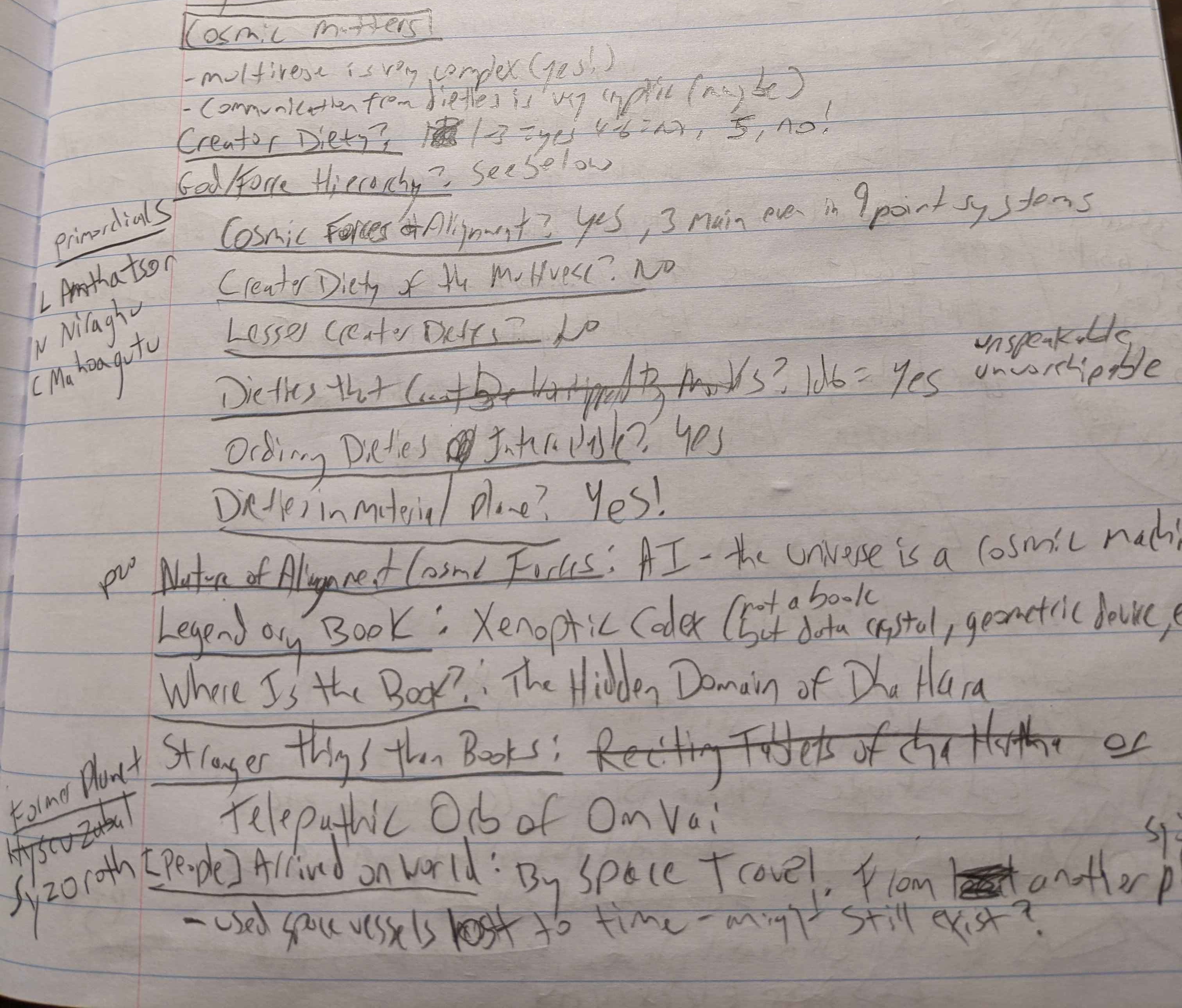
- Instead of being created by a deity, the universe was formed when the Cosmic Machine's forces of Law, Neutrality, and Chaos interacted in just the right way.
- The Cosmic Machine is itself the universe, intelligent, and artificial.
- These forces are known as the Primordials Ahmthatsor, Niraghu, and Mohoagutu.
- The universe has multiple planes, gods, and other powerful beings and places outside of the material world.
- The gods are hard to understand and the their desires are open to interpretation and misunderstanding.
- Some gods are not worshipable and some not nameable.
- There are deities and godlike beings that reside on the material plane.
- There is a legendary item of knowledge known as the Xenoptic Codex that can be found in The Hidden Domain of Dha Hara.
- Dha Hara is most likely a banished and unworshipable deity.
- Another strange artifact is the Telepathic Orb of OmVai. OmVai might be one of the immortal godlike beings.
- The sentient species of the setting came from the planet Syzoroth on a colony ship, long ago crashed and forgotten.
Next
In the next chapter, we get down to earth and start mapping things out. Edit: Ok, not quite yet but we do look at the world itself.